
Bawal Bastos Law: Guide to the Safe Spaces Act in the Philippines


🐰 TL;DR
The Safe Spaces Act legally protects you from gender-based sexual harassment in public, professional, academic, and online spaces across the Philippines. It strictly penalizes offenders to ensure your personal safety.
- It penalizes verbal, physical, and digital harassment across all settings.
- Legal updates actively target modern threats like AI-generated harassment.
- Collect clear evidence like timestamps and screenshots immediately after incidents.
- Submit formal complaints to local barangay desks or cybercrime units.
Navigating your daily routine requires basic security: you shouldn’t have to look over your shoulder every time you leave the house. You deserve to walk down the street, commute to work, or scroll through your social media feeds without anticipating unsolicited comments. Unfortunately, unwanted advances and harassment remain a frequent reality for many people.
The Safe Spaces Act or Bawal Bastos Law exists specifically to draw a hard line against this behavior. This legislation actively penalizes gender-based sexual harassment across physical environments and digital platforms. This guide breaks down exactly what the law covers, the penalties for offenders, and how you can exercise your rights to enforce your personal boundaries.
What is the Safe Spaces Act (Bawal Bastos Law)?
Republic Act No. 11313, or the Safe Spaces Act of 2019, is a Philippine law designed to prevent and penalize gender-based sexual harassment across public spaces, workplaces, educational institutions, and online platforms.
The legislation explicitly protects all individuals from unsolicited sexual advances, misogynistic remarks, homophobic or transphobic slurs, and technology-facilitated violence, regardless of their gender identity or sexual orientation.
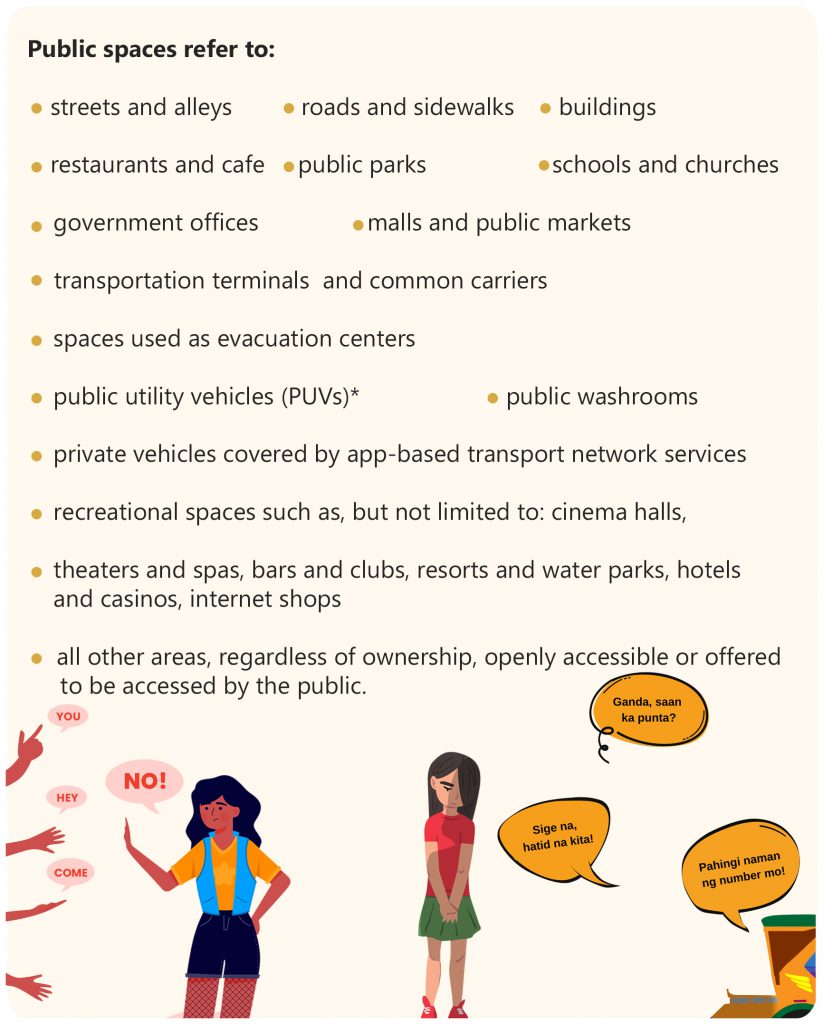
You don’t have to tolerate invasive behavior as an unfortunate fact of life. This law transforms the concept of a safe environment into a legally enforceable right. Whether you’re walking down the street, sitting in a corporate office, or browsing social media, the law places the burden of decency on the offender, shifting the focus away from victim-blaming and demanding strict accountability for harassment.
Consent and bodily autonomy
The Safe Spaces Act actively reshapes how society views personal boundaries. At its core, the law reinforces one absolute truth: your body belongs to you. You alone dictate who interacts with it. This deep respect for bodily autonomy plays out in two major ways:
- In public environments: You enforce boundaries by demanding basic respect. You now have the legal backing to shut down unsolicited comments, stares, and physical advances.
- In private spaces: You take complete ownership of your comfort, intimacy, and sexual health. You get to define exactly what feels good and what doesn’t.
True empowerment means calling the shots in every single setting. When you feel secure in your right to consent, exploring your personal desires becomes a natural extension of that freedom.

Where Does the Bawal Bastos Law Apply? Physical and Digital Spaces
Harassment rarely stays confined to one setting. Because your daily routine spans multiple environments, the Safe Spaces Act enforces strict boundaries across both physical and virtual locations to protect you wherever you go.
Here are the specific areas covered:
- Public and private establishments: You have a right to safety on public streets, inside alleys, and across commercial spaces like restaurants and malls. The mandate also holds transportation operators directly accountable. If a driver commits gender-based harassment inside a public utility vehicle, the Land Transportation Office can permanently cancel their license.
- Professional Settings: The Bawal Bastos Law demands a zero-tolerance policy at work. Employers must create an internal committee to investigate and resolve complaints. These regulations apply strictly to supervisors, peers, and clients.
- Academic Institutions: Schools and training centers must actively protect their students. Recent legislative efforts by the Philippine Commission on Women (PCW) explicitly push to include student interns and trainees under these core protections.
Digital shift
Your online presence requires the exact same level of security as your physical one. Social media platforms, messaging apps, and forums remain notorious hotspots for unwanted sexual remarks, cyberstalking, and the unauthorized sharing of private images.
To keep up with evolving threats, ongoing updates championed by the Department of the Interior and Local Government (DILG) focus heavily on technology-facilitated violence. Current legislative measures, such as Senate Bill 2897 and House Bill 5198 introduced between 2025 and 2026, target modern abuses like AI-generated harassment and digital grooming.
The government legally recognizes that a screen provides zero excuse for abuse. You are fully entitled to navigate digital spaces free from targeted psychological distress.
Prioritizing your pleasure requires a foundation of total safety. If you’re ready to explore your intimacy on your own terms, Pink Bunny offers a secure, judgment-free avenue to do exactly that. Our carefully curated selection of adult toys helps you celebrate your bodily autonomy and confidently enhance your personal wellness journey.
Violations and Penalties of the Safe Spaces Act
Knowing your rights means knowing exactly when someone crosses the line. The Bawal Bastos Law categorizes offenses by severity to ensure that all forms of harassment carry appropriate legal consequences. Not every interaction violates the law, so understanding the distinction helps you identify actionable offenses quickly.
Bawal bastos violation checklist
Use this quick reference to distinguish between standard social interactions and legally punishable harassment:
| Harmless Interaction | Legally Actionable Harassment |
|---|---|
| Asking a stranger for directions | Relentlessly requesting personal details, contact info, or a destination |
| Briefly glancing at someone in passing | Intrusive gazing, leering, or relentless staring |
| Complimenting a colleague’s professional work | Making persistent, unsolicited comments about someone’s physical appearance |
| Bumping into someone by accident in a crowd | Deliberately brushing against, pinching, or groping a person’s body |
Escalating penalties for offenders
The law imposes increasingly severe penalties based on the degree of the offense and whether the perpetrator is a repeat offender.
| Offense Category | Examples of Violations | Potential Penalties (Ranging from 1st to 3rd Offense) |
|---|---|---|
| First Degree (Verbal) | Catcalling, wolf-whistling, sexist slurs, unwanted invitations | ₱1,000 to ₱10,000 fine, 12 hours community service, up to 30 days imprisonment |
| Second Degree (Gestures & Exhibitionism) | Offensive body gestures, public masturbation, flashing | ₱10,000 to ₱20,000 fine, 11 days to 6 months imprisonment |
| Third Degree (Stalking & Contact) | Stalking, unauthorized touching, deliberate brushing against the body | ₱30,000 to ₱100,000 fine, 1 to 6 months imprisonment |
| Online Harassment (Digital Spaces) | Cyberstalking, sending unauthorized intimate media, online grooming | ₱100,000 to ₱500,000 fine, 6 months to 6 years imprisonment |
How to Document Incidents and File a Formal Report
If you experience harassment, taking swift action gives your case the strongest possible foundation. Follow this concrete process to secure your rights under the Safe Spaces Act:
1. Document the evidence immediately
Jot down the exact date, time, and location of the incident while the details remain fresh. Note the specific words spoken or physical actions taken. If the violation happens online, grab screenshots immediately. Capture the offender’s profile, the harmful messages, and the specific URL before they delete the evidence.

2. Seek assistance from the right authority
Where you file your report depends directly on where the harassment occurred. Match the location of the incident to the appropriate enforcer:
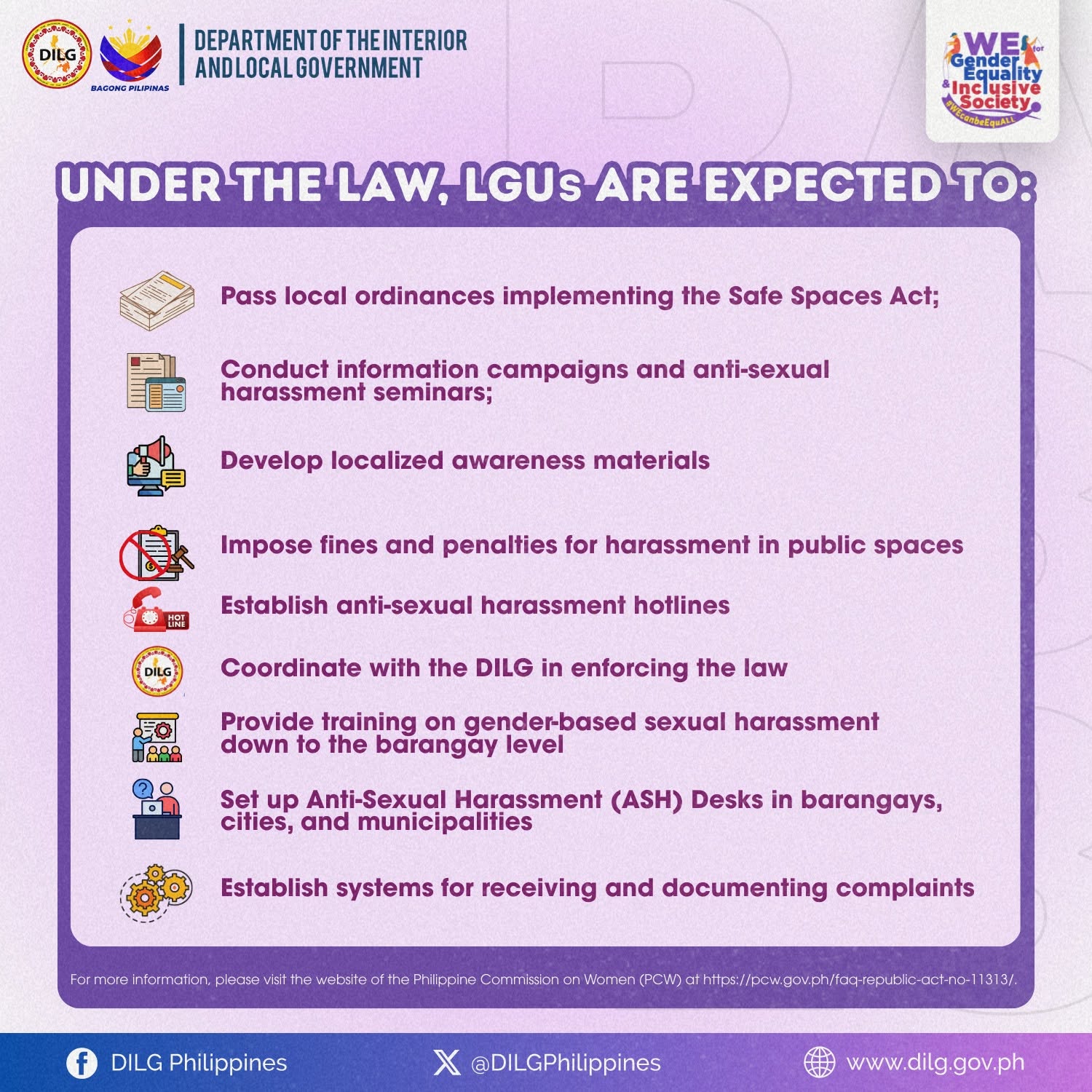
- Any public setting (general): Call your LGU’s Anti-Sexual Harassment (ASH) hotline. You can also visit the nearest police precinct’s Women and Children’s Protection Desk, the Local Social Welfare and Development Office, or the Public Attorney’s Office (PAO) for legal assistance.
- Streets, alleyways, and parks: Flag down the nearest local traffic enforcer or patrolling police officer.
- Public utility vehicles (PUVs): Report the offending driver or operator directly to a traffic enforcer, the Land Transportation Office (LTO), or the LTFRB.
- Malls, bars, and commercial establishments: Notify the establishment’s designated ASH Officer or their head security personnel.
- Workplaces and schools: Submit a formal written report to your institution’s Committee on Decorum and Investigation (CODI).
- Digital platforms: Forward your screenshots to the Philippine National Police Anti-Cybercrime Group so they can launch an official investigation.
Taking Control of Your Safety
Understanding your protections gives you the essential leverage to call out harassment, protect your peers, and reclaim total control over your environment. By demanding accountability in public, professional, and digital spaces, you actively help foster a culture where personal boundaries remain absolute.

True empowerment means confidently taking charge of your personal wellness, both out in the world and behind closed doors.
When you’re ready to explore your desires in a completely judgment-free space, Pink Bunny supports your journey to absolute autonomy. As a trusted adult shop in the Philippines, we offer an extensive, body-safe selection ranging from a premium vibrator sex toy to high-quality dildos and beginner-friendly anal toys.
Your privacy and convenience always come first, which is why every order features 100% discreet packaging. You can enjoy free delivery on all orders over ₱1,490, a cash-on-delivery option, or our same-day delivery service if you’re located within NCR.
If you have any questions about choosing the perfect products for your intimate wellness journey, feel free to reach out to our team at 0928 382 8623 on WhatsApp and Viber, or drop by our branches in Makati, Quezon City, Cebu, and Angeles.
Safe Spaces Act (Bawal Bastos Law): FAQs
The law penalizes any unwanted sexual actions or remarks directed at another person. This includes catcalling, intrusive gazing, relentless requests for personal details, and homophobic or transphobic slurs. The offender’s intent doesn’t matter; the law focuses entirely on the recipient’s feeling of harassment and their lack of consent.
The Safe Spaces Act applies across four main environments: streets and public spaces, workplaces, educational institutions, and digital platforms. You’re legally protected from gender-based sexual harassment whether you’re commuting on a jeepney, eating at a restaurant, or browsing your social media feeds.
The 1995 law only penalized harassment committed by superiors or people in authority within work or academic settings. The Bawal Bastos Law significantly expands these protections. It now criminalizes harassment from peers, subordinates, and complete strangers across public and online spaces.
Anyone who experiences gender-based sexual harassment can immediately file a formal complaint. The law explicitly protects all individuals, regardless of their sex, sexual orientation, or gender identity and expression. You can submit your report to your local barangay‘s Anti-Sexual Harassment desk, the police, or your school/workplace committee.