

Every day, thousands of Filipinos open a browser and quietly type questions about who they are. They search for “gender identity,” “non-binary,” “intersex,” “silahis,” and the SOGIE Equality Bill. They also search for strap-ons, lubricants, and sex toys related to LGBTQ+ sexual wellness in the Philippines. But in many cases, they find very little that speaks directly to them.
There is a version of this story that is easy to tell: the Philippines is a deeply Catholic country with conservative social values, and so questions about queer identity and sexual wellness are suppressed. The silence is cultural, and the gaps are expected, but the situation is slowly improving. That version is comfortable because it asks nothing of anyone. It positions the gap as the inevitable consequence of the Philippines’ cultural evolution and implies that time alone will close it.
Search data is not a comfortable medium. It does not deal with impressions, public narratives, or what a country says about itself. It deals with what people do when no one is watching—the questions typed or the curiosity that exists regardless of what the culture permits.
Filipino search data shows a population whose private curiosity is substantially larger, more specific, and more urgent than the public institutions are prepared to meet.
This article draws on five proprietary data sources, including Google’s Keyword Planner (GKP), and cross-references them against data from the World Health Organization, the Philippine Department of Health, the Trevor Project’s 2024 national survey, the Philippine Commission on Human Rights, the Department of Education, and peer-reviewed public health research.
That gap between what people are asking and what the world offers in response is what the findings in this article attempt to map. Some of the answers the data reveals are striking and troubling, but all point toward a population that is not waiting for permission to be curious, and an institutional landscape that has not caught up with that curiosity.
The Global Standard on Sexual Health and How the Philippines Measures
The World Health Organization defines sexual health as, “a state of physical, emotional, mental, and social well-being in relation to sexuality; it is not merely the absence of disease, dysfunction or infirmity. Sexual health requires a positive and respectful approach to sexuality and sexual relationships, as well as the possibility of having pleasurable and safe sexual experiences, free of coercion, discrimination, and violence.“[1]
Critically, the WHO adds: “For sexual health to be attained and maintained, the sexual rights of all persons must be respected, protected and fulfilled.“[1] A December 2024 special edition of the WHO Bulletin, dedicated to sexual health across the life course, identified strengthening human rights frameworks and expanding access for people of diverse sexual orientation and gender identity as priority areas globally.[2]
The Philippines is a signatory to the international human rights instruments the WHO references, including the International Covenant on Civil and Political Rights and the Universal Declaration of Human Rights. But as the data to follow demonstrates, the gap between international commitment and domestic reality remains significant.
Finding 1: Pride Month Searches Fell 19%; The Questions Didn’t
How Pride Month search volume in the Philippines is changing
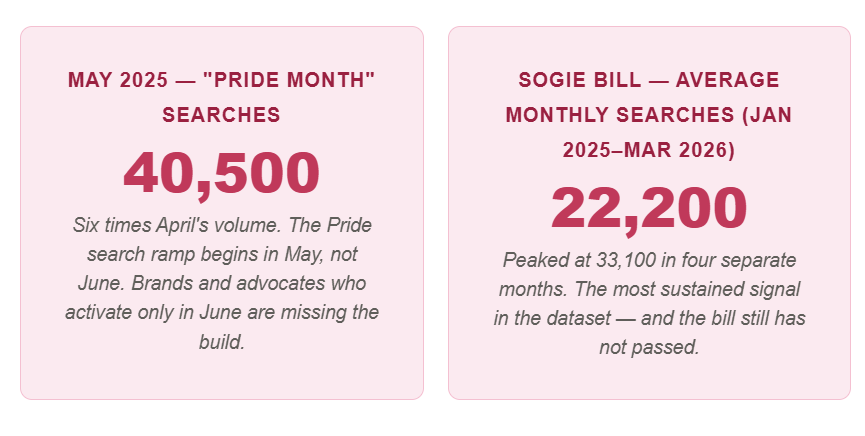
GKP data for the Philippines shows “pride month” generating a June 2025 peak of 90,500 searches—a 19% year-on-year decline from its 2024 peak. But the monthly breakdown reveals something: Pride Month search interest in the Philippines is concentrated in two weeks, with a May ramp-up that most campaigns miss entirely.
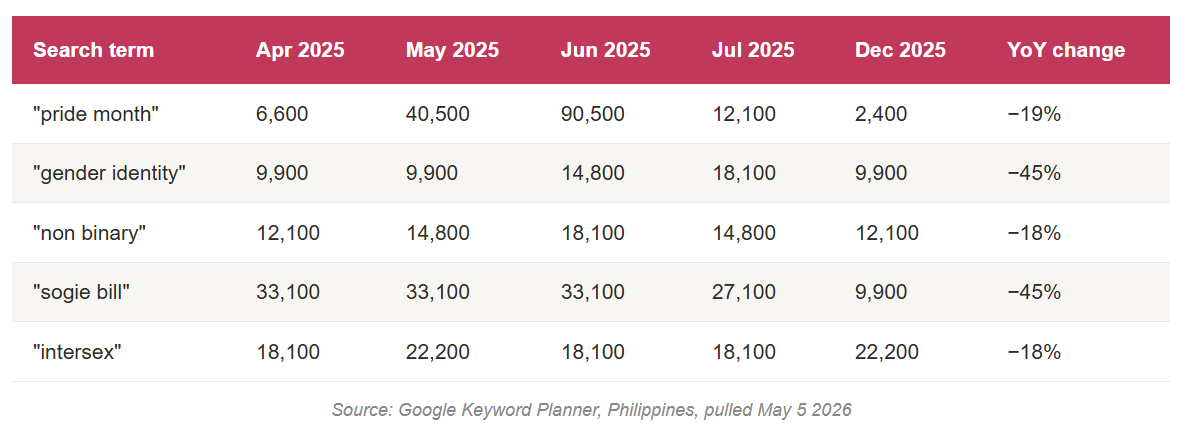
While event-driven Pride searches declined year-on-year, core queer identity searches remained substantial throughout the period, independent of Pride Month. “Gender identity” averaged 14,800 monthly searches. “Intersex” averaged 22,200 with zero decline in the most recent three months. “Non-binary” peaked at 18,100 in June 2025.
What does it mean when Pride fades, but curiosity doesn’t?
There is a temptation to read the 19% decline in Pride Month searches as worrying evidence that Filipino society is pulling back from queer visibility. The data argues otherwise. What appears to be a retreat from Pride is, on closer reading, a maturation. The declining search terms are event-driven: “pride month,” “pride parade manila,” and “pride celebration.”
The search terms that are holding or growing are the identity-driven: “gender identity,” “non-binary,” “intersex,” and “sogie bill.” Filipinos are not searching less for queerness. They are searching for it more personally, more specifically, and more continuously.
When a community is newly visible, it generates high-volume event-driven searches—people looking to witness something novel. As visibility matures, the searches become quieter and more individual. People are no longer asking “what is pride?” They are asking, “Who am I?” That shift is not a contraction; it is a deepening in understanding.
“The decline in Pride Month searches does not reflect declining interest in queer identity. It reflects something more mature: a population that no longer needs a single annual event to give permission to ask questions about who they are. The questions have become year-round. The infrastructure to answer them has not kept up.”— Rozaira Angulo, Owner, Pink Bunny Philippines
Finding 2: The Philippines is the World’s 2nd Most Curious Country About Gender Identity, with No Law and a Documented Mental Health Crisis
The SOGIE Equality Bill, filed in the 20th Congress in July 2025 by Senators Hontiveros and Legarda [3] and filed simultaneously with House Bill 5266 in the lower chamber[4], now holds the record as the longest-running bill in Philippine Senate history, first having been filed in the 11th Congress in 2000.[5]
The Commission on Human Rights has repeatedly urged its passage, noting that it aligns with the Philippines’ commitments under the 1987 Constitution and international human rights covenants.[6]
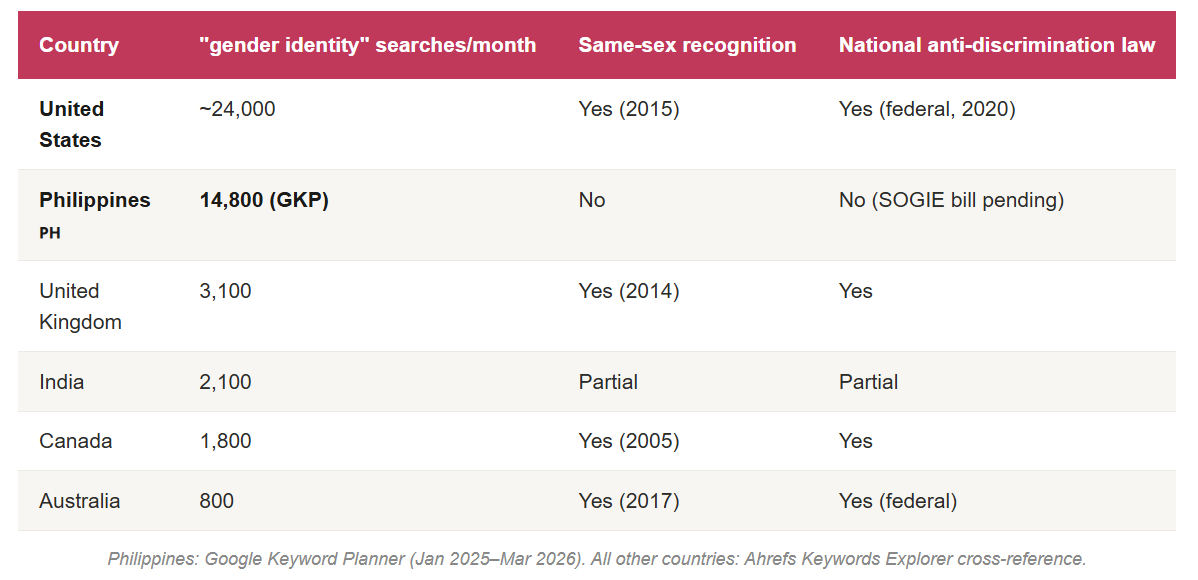
GKP lists the Philippines at 14,800 monthly searches for “gender identity”—the second-highest globally, behind the United States. The United Kingdom generates 3,100, Canada 1,800, and Australia 800. Per capita, the Philippines generates more gender identity curiosity than every developed nation with formal LGBTQ+ legal protections.
Behind those searches is a documented mental health toll. The Trevor Project’s 2024 Philippines National Survey on LGBTQ+ Young People—the first country-wide survey of its kind—found that 74% of LGBTQ+ young Filipinos had experienced discrimination due to their sexual orientation or gender identity and expression.
Nearly two-thirds said their identity felt like a burden, and more than half did not feel comfortable interacting with others as their true selves.[7]
Furthermore, a 2024 qualitative study in the journal Sage Open Medicine found that the Philippine healthcare system lacks sufficient affirming services for sexual and gender minorities, with some providers still engaging in conversion therapy—a practice condemned by the WHO and every major medical body globally.[8]
A separate 2024 peer-reviewed study found that LGBTQ+-specific content is largely absent from the current Philippine medical and nursing curriculum.[9]
The contradiction at the heart of the data
Finding 2 contains a profound contradiction: the Philippines generates the second-highest volume of gender identity searches in the world, but also has no national laws protecting people based on their gender identity.
It has a healthcare system that peer-reviewed evidence shows is not trained to serve LGBTQ+ patients and a political record of 25 years of inaction on the very legislation its citizens keep searching for.
In any country where the law and the health system are actively affirming, that level of search curiosity would be met by institutional infrastructure — public health campaigns, school-based education, clinical guidelines, and accessible healthcare pathways. In the Philippines, the curiosity lands in a relative void.
The 14,800 monthly searches for “gender identity” are not being answered by the system. In many cases, they are being answered by whatever Google surfaces, which may or may not be accurate, culturally appropriate, or safe.
The Trevor Project data gives us a human dimension for what that void costs. When 74% of young LGBTQ+ Filipinos report having experienced discrimination, and 63% say their identity felt like a burden, we are not looking at the outcome of individual prejudice alone. We are looking at an indifference that search data renders visible with uncomfortable precision.
“When a population searches for ‘gender identity’ 14,800 times a month, they are telling us something clinical. They are seeking information that they are not getting from school, from healthcare providers, or from the law. Search data is a proxy for unmet informational need, and in this case, the need is immense.” — Dr. Ma. Bernadette C. Nolasco, In-House Sexual Health Advisor, Pink Bunny Philippines
Finding 3: 184,000 Monthly Queer Sex Searches, a 300-to-1 Commerce Gap, and a Worsening HIV Crisis That No One is Talking About
Google Keyword Planner shows “gay sex” averaging 90,500 searches per month in the Philippines across the 15 months, with 110,000 monthly searches from January through August 2025. “Lesbian sex” averaged 60,500, peaking at 74,000.
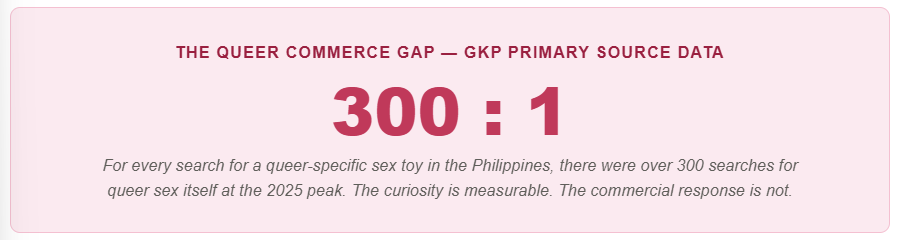
Combined, these two terms generated approximately 184,000 monthly searches between January and August 2025. Searches for queer-specific sex toys fell below Google’s minimum reporting threshold, which is fewer than an estimated 600 combined monthly searches.
This gap intersects with one of the most urgent public health crises in the country. The Department of Health reported 57 new HIV cases per day by May 2025, a figure that had grown from 21 per day in 2015, which is a 171% increase in a decade.[10] The first quarter of 2025 alone recorded 5,101 new HIV cases, or a 50% increase compared to the same period in 2024.[11]
Why access to sex toys and lubricants is a public health issue, not just a retail one
Access to accurate information about sexual health—including how to use lubricant correctly for anal sex, how to clean toys, and how to discuss safer sex with partners is a documented factor in HIV prevention outcomes.[12]
When the commercial and educational infrastructure for queer sexual wellness is essentially absent, and when 75% of the men most at risk have never been tested, the 300-to-1 search gap is not just a retail observation; it is a public health finding.
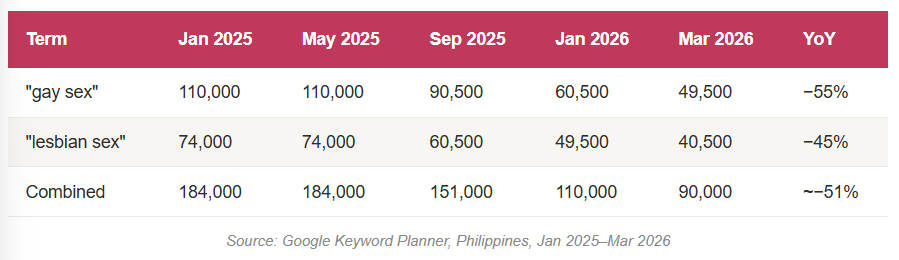
The declining volume of queer sex searches over the period is as significant as its peak. From January to August 2025, “gay sex” ran at a consistent 110,000 searches per month in the Philippines. By March 2026, that figure had fallen to 49,500—a 55% decline over eight months. “Lesbian sex” followed a near-identical trajectory, falling from 74,000 to 40,500.
This sustained, directional decline is not a data artefact. It reflects a shift in how queer Filipinos are finding sexual content, likely a migration toward social media platforms, encrypted messaging apps, and niche communities that do not generate Google search traffic.
This migration is well documented in global digital behaviour research: as platforms like TikTok, Telegram, and community forums become better at serving identity-specific content, broad Google searches for sexual content decline even as underlying interest remains unchanged.
What this means for the commerce gap is urgent: the audience that existed at 184,000 monthly peak searches is not disappearing, it is migrating to spaces where it is harder to reach through conventional search-driven commerce.
The window to establish first-mover presence as an explicitly queer-affirming sexual wellness brand in Philippine search is contracting. Brands that show up now—with queer-specific product framing, education, and language—will establish authority in a space that will be increasingly difficult to enter through organic search alone as the migration continues.
The HIV data make the urgency non-optional. At 57 new diagnoses per day, the Philippines is not managing an accelerating public health situation. The 171% increase in daily diagnoses since 2015 is not a trend that reverses on its own.
And the interventions that public health evidence consistently supports—access to accurate information, destigmatised product access, and affirming healthcare—are precisely what the 300-to-1 commerce gap shows is absent.
“A 300-to-1 ratio between queer sexual curiosity and product access is not a business gap; it is a health equity gap. Filipinos who cannot access safe, appropriate, and affirming sexual wellness products are not missing convenience. They are missing health. And the HIV data shows us what that absence costs.”— Dr. Ma. Bernadette C. Nolasco, In-House Sexual Health Advisor, Pink Bunny Philippines
Finding 4: Queer Customers are Already Inside Adult Shops, 2,033 Strap-On Searches, and Limited Queer-Specific Guidance to Meet Them
Internal retail data from our website adds a layer that no external dataset can: what consumers do once they have already entered a sexual wellness retailer.
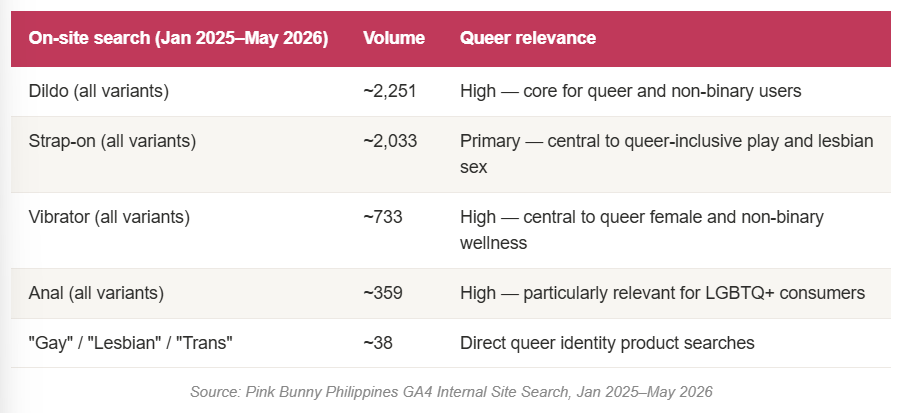
Between January 2025 and May 2026, visitors submitted more than 2,033 searches for strap-on and related terms—the second-most-searched category after dildos.
National GKP data provides market context. “Butt plug” generates 18,100 per month, with +22% YoY growth—the only queer-relevant product category to show confirmed year-on-year growth.
“Strap on harness” grew +86% year-on-year, “strapless strap on” grew +88%, and “pegging” averages 18,100 per month with zero YoY change—one of the most stable signals in the queer wellness dataset. All carry low competition ratings in GKP, meaning these are commercially underserved search terms.
Google Search Console data confirms the commercial picture: strap-on pages generated over 120,000 combined impressions over 16 months on pinkbunny.ph, with strap-on dildo sets converting at a 5.6% key event rate and ₱21,680 in verified revenue from Google Analytics 4 without any explicit queer-facing framing on the page.
What the store data tells that national search data cannot
There is an important distinction between national search data and on-site search data. National data tells us that Filipinos are curious. On-site search data shows that specific individuals have acted on that curiosity, arrived at a destination, and still needed more than the store could provide. The gap between those two things is where the real insight lives.
Consider what it takes for a person in the Philippines to arrive at a sexual wellness retailer’s website and type “strap on” into the search bar. They have already navigated stigma, social visibility, the risk of being seen on their screen, and the discomfort of seeking out a product category their culture does not publicly acknowledge.
Once a customer searches on-site, they have already cleared the barrier to entry. The question they are asking is not “Am I allowed to want this?” but “Can you help me find what I need?”
When those 2,033 strap-on searches returned product grids without queer-specific guidance—without language about which harnesses work for which bodies, education about how strap-on play differs depending on anatomy, or acknowledgement that the person searching might be a lesbian couple, a non-binary person, or anyone other than a presumed heterosexual buyer—what was communicated, however unintentionally, was that the store was not quite for them. That gap cannot be solved by stocking more products, but by knowing who is in the store.
“Internal search data is the most honest dataset a retailer like us has. It shows not what people browse, but what they cannot find by browsing. Over 2,000 strap-on searches on-site in 16 months mean over 2,000 moments when a customer needed guidance that a product grid alone could not provide. That is not a navigation problem. It is an inclusion problem.” — Rozaira Angulo, Owner, Pink Bunny Philippines
Finding 5: Filipino Queerness is Finding Its Own Language, and the Data Shows Western LGBTQ+ Terminology Giving Way
One of the most culturally significant findings in this dataset only emerged from Google Keyword Planner data. While Western LGBTQ+ terminology is declining sharply in Filipino search behaviour, indigenous Filipino queer identity terms are growing given how vast LGBTQ+ history in the Philippines is.
Silahis, the Filipino term for bisexuality that came from a gemstone that catches light from multiple angles, grew 26% year-on-year to 2,400 monthly searches. “Tomboy Philippines” grew 51% year-on-year, while “transpinay” held steady; “lgbtq rights” fell 70%, and “lgbtq Philippines” fell 35%.
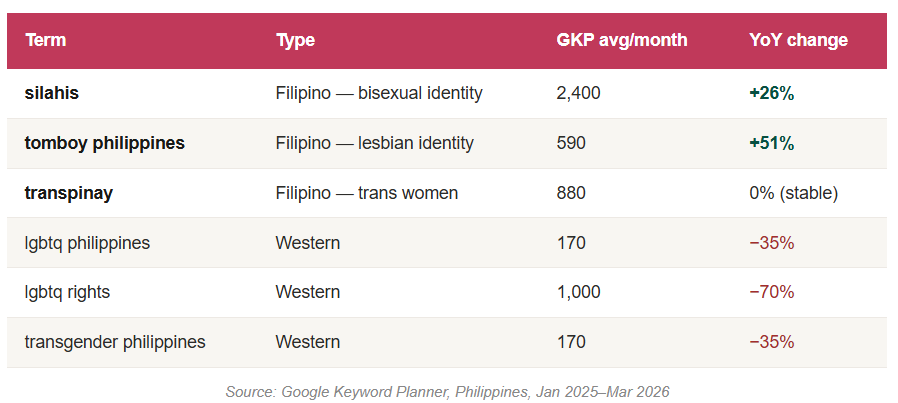
This is consistent with the findings of a 2024 peer-reviewed study that called for healthcare curricula to integrate LGBTQ+ health content using “local LGBTQ+ culture, norms, terminologies, and policies,” explicitly recognising that Filipino queer identity is culturally distinct from Western frameworks.[9]
The WHO’s 2024 Bulletin similarly called for culturally contextualised approaches to sexual health across diverse populations.[2]
To understand why this finding matters, it helps to know what these terms actually carry. Silahis is not simply the Tagalog word for bisexual; it carries a cultural weight that the Western term does not. Its root word—silab, meaning to catch fire or to gleam—and its association with the gemstone, evokes something more poetic than a clinical category.
It is a word chosen, not translated. Tomboy, in Philippine usage, refers specifically to masculine-presenting women who are attracted to women, which is narrower and more community-specific than its English connotation, but has become almost meaningless through overuse.
Transpinay, a portmanteau of “trans” and “Pinay,” the colloquial term for a Filipino woman, is a term of self-naming, coined within the community to describe an experience that borrowed vocabulary could not fully hold.
When Filipinos search for these terms in growing numbers while Western LGBTQ+ terminology declines, they are not simply choosing different words. They are choosing a different relationship to their own identity, one rooted in local culture, history, and a sense of self that predates the arrival of Western queer frameworks.
Philippine culture has always had space for gender and sexual diversity: the babaylan tradition of spiritual leadership by gender-variant individuals goes back centuries before colonisation introduced both Christianity and the European binary of normal and deviant.
What this means for health communication, education, and commerce is that content built exclusively around LGBTQ+ as a monolithic category will increasingly miss its target audience.
A health campaign that speaks to the LGBTQ+ community without acknowledging bakla, silahis, or transpinay as distinct identities with distinct experiences is a campaign that speaks past rather than to the people it claims to serve.
The search data is telling us something the health, advocacy, and commercial sectors have been slow to hear: that the Filipino queer community is in the process of claiming its own terms.
“When people find language for their identity—language that belongs to their own culture—they are more likely to seek care, seek community, and seek wellness resources. The growth of indigenous Filipino queer vocabulary in search data is not a linguistic curiosity. It is a clinical signal that deserves a clinical response.” — Dr. Ma. Bernadette C. Nolasco, In-House Sexual Health Advisor, Pink Bunny Philippines
Finding 6: “Sex Education Philippines” Searches Collapsed 95% as DepEd Acknowledges Implementation Gaps and HIV Cases Accelerate
GKP records one of the most dramatic collapses in the dataset: “sex education Philippines” fell from 18,100 searches in January 2025 to 880 in March 2026—a 95% decline in 14 months. This is not seasonality; this is sustained and shows no sign of recovery.
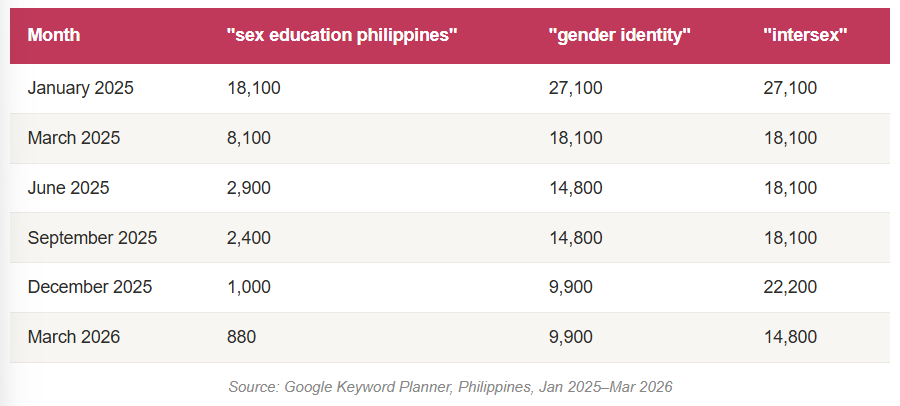
This collapse does not occur in a vacuum. The Department of Education formally acknowledged in January 2025 that its Comprehensive Sexuality Education (CSE) program, mandated under DepEd Order No. 31, Series of 2018, faces “inconsistent” implementation due to “cultural resistance, insufficient teacher training, and lack of instructional resources.”[13]
A 2025 peer-reviewed content analysis published in the International Journal of Educational Contemporary Explorations found “significant disparities” between DepEd’s policy intentions and actual classroom implementation.[14]
Sex education collapses, but identity questions keep growing
The juxtaposition is the clinical finding: Filipinos have not stopped asking questions about queer identity and sexual health. They are no longer finding an educational infrastructure to answer them.
“Gender identity” holds above 9,900 searches every single month, while “intersex” averages 22,200. The questions are year-round. The educational response has effectively collapsed.
When formal sex education infrastructure weakens, whether through curriculum gaps, teacher reluctance, cultural resistance, or the simple failure to reach the students who need it, someone else fills the space.
In 2026, that someone is usually a combination of social media, peer networks, online pornography, and whatever a search engine surfaces when a teenager types their question at midnight in private. None of these is a reliable substitute for structured, medically accurate, age-appropriate, and identity-affirming education.
The danger for queer young Filipinos is that the informal information ecosystem they navigate is not designed with their safety in mind. Social media algorithms, while increasingly queer-friendly globally, are heavily shaped by the Philippine regulatory and cultural environment, which remains restrictive.
Online pornography—often the first place young people get information from about queer sex—rarely presents any of the context necessary for safe practice: consent, lubrication, anatomical realities of anal sex, or HIV transmission and prevention. Peer networks, while emotionally vital, carry misconceptions of communities that have themselves been miseducated.
The collapse of sex education searches while queer identity searches remain robust is a clinical alert—95% fewer people use Google to find it, meaning they are finding it somewhere else, or not at all. It also suggests that those most in need of education may be the same people left behind by the shift that caused the decline, and HIV data tells us the cost of that gap in lives.
What Search Data Asks Us All About LGBTQ+ Sexual Wellness in the Philippines
The six findings above do not describe a niche audience. They describe a significant portion of the Filipino population—one who generates tens of thousands of searches about queer identity, searches for legislation that has been stalled for 25 years in Congress, builds a queer vocabulary in their own language, walks into a store and finds limited guidance, and experiences a worsening HIV crisis while sex education infrastructure collapses.
WHO’s working definition of sexual health explicitly requires that it be free of discrimination and that sexual rights be protected.[1] By that definition, sexual health has not yet been fully attained for queer Filipinos, not because the curiosity is absent, but because the conditions for it are not in place.
The findings in this report describe a single pattern, not six problems. Filipino queer identity is real, substantial, and measurable. You can count it in search volumes, on-site behaviour, and the persistence of SOGIE Bill as the most consistently searched piece of legislation.
What has not kept pace with that identity is the institutional response to it: the laws that would protect it, the healthcare system that would affirm it, the education system that would contextualise it, and the commercial infrastructure that would serve it.
That gap between a population’s curiosity and the world’s readiness to meet that curiosity is what we have called the curiosity gap. And it is, in the fullest sense, a public health crisis.
Pink Bunny’s Commitment to LGBT Sexual Health
At Pink Bunny, we are one small part of the response. We believe that inclusive, affirming, and accurate sexual wellness resources—both informational and commercial—are a component of the public health infrastructure that the WHO’s definition requires.
One of the most concrete things we can do right now is make it easier for queer Filipinos to access the products that serve them.
This Pride Month, we are offering 10% off all strap-ons and anal toys exclusively for online purchases — because the 2,033 on-site strap-on searches in this dataset were not an abstraction, and neither are the people behind them. Use code PRIDE10 at checkout.
FAQs About LGBTQ+ Sexual Wellness in the Philippines
How many Filipinos search for “gender identity” every month?
According to Google Keyword Planner data pulled in May 2026, the Philippines generates approximately 14,800 monthly searches for “gender identity”—the second-highest volume of any country in the world, behind only the United States (approximately 24,000 per month). The United Kingdom generates 3,100, and Canada 1,800.
Has the SOGIE Equality Bill been passed in the Philippines?
As of May 2026, the SOGIE Equality Bill has not been passed. It was refiled in the 20th Congress in July 2025 and holds the record as the longest-running bill in Philippine Senate history, having first been filed in the 11th Congress in 2000. Filipinos search for it over 22,200 times per month, peaking at 33,100 during Senate session months.
What is the current HIV situation in the Philippines for LGBTQ+ people?
The Department of Health reported 57 new HIV cases per day by May 2025, up from 21 per day in 2015, or a 171% increase in a decade. Approximately 70% of cases involve men who have sex with men (MSM), and over 75% of MSM have never been tested, largely due to stigma and lack of access to affirming healthcare spaces.
UNDP projects the Philippines could reach 401,700–500,000 people living with HIV by 2030 without intensified intervention.
What does silahis mean, and why is it significant in Philippine LGBTQ+ data?
Silahis is a Filipino term for bisexuality, named after a gemstone that catches light from multiple angles. GKP data shows it growing +26% year-on-year to 2,400 monthly searches, while Western LGBTQ+ terminology like “lgbtq rights” fell 70% over the same period.
This signals a cultural shift toward indigenous Filipino queer identity language, a finding corroborated by 2024 peer-reviewed research calling for Filipino queer health content to use local terminology.
Why did “sex education Philippines” searches collapse so dramatically?
Google Keyword Planner shows “sex education Philippines” fell from 18,100 monthly searches in January 2025 to just 880 in March 2026, an 95% decline in 14 months. DepEd acknowledged in January 2025 that its Comprehensive Sexuality Education (CSE) program faces “inconsistent” implementation due to cultural resistance and insufficient teacher training.
The cause of the search collapse is not determinable from search data alone, but the outcome is clear: queer identity questions are still being asked at scale, while the educational framework to answer them has effectively disappeared from search.
Where can LGBTQ+ Filipinos find queer-inclusive sex toys and sexual wellness products in the Philippines?
Pink Bunny Philippines carries strap-ons, harnesses, anal toys, lubricants, vibrators, and a full range of queer-inclusive sexual wellness products. All orders are available online at pinkbunny.ph, with discreet packaging and delivery anywhere in the Philippines, as well as in physical stores in Manila, Makati, Cebu, and Angeles.
What is the queer commerce gap in the Philippines?
The queer commerce gap refers to the disparity between how many Filipinos search for queer sexual content (approximately 184,000 monthly for “gay sex” and “lesbian sex” combined at the 2025 peak) and how few search for queer-specific sexual wellness products (fewer than an estimated 600 monthly searches).
This produces a ratio of approximately 300:1; for every search for a queer sex toy, there are over 300 searches for queer sex itself. Our in-house Sexual Health Advisor argues this is not merely a commercial gap but a health equity gap.
References and Citations
- World Health Organization. Sexual health. Accessed May 2026. who.int/health-topics/sexual-health
- World Health Organization. Advancing sexual health and wellbeing and rights: December edition of the WHO Bulletin. December 11, 2024. who.int
- Wikipedia contributors. SOGIE Equality Bill. Wikipedia, updated March 2026. en.wikipedia.org
- House of Representatives, Republic of the Philippines. HB 5266 — SOGIESC Equality Act. Filed October 2025. docs.congress.hrep.online
- Rappler. Why is it taking so long to pass the SOGIESC Bill? June 30, 2025. rappler.com
- Commission on Human Rights, Philippines. SOGIE Equality Bill — CHR statements and positions. Accessed May 2026. chr.gov.ph
- The Trevor Project. 2024 Philippines National Survey on the Mental Health of LGBTQ+ Young People. 2024. thetrevorproject.org
- Alibudbud R. Addressing Mental Health Stigma and the Challenges Faced by Sexual Minority Men: Insights from the Philippines. Sage Open Medicine, 2025. pmc.ncbi.nlm.nih.gov
- Alibudbud R. Enhancing Nursing Education to Address LGBTQ+ Healthcare Needs: Perspectives from the Philippines. Sage Open Medicine, 2024. pmc.ncbi.nlm.nih.gov
- DevelopmentAid. Philippines youths in the center of HIV/AIDS epidemic. June 2025. developmentaid.org
- DOH / SHIP Philippines. HIV and AIDS Surveillance of the Philippines (HASP) Q1 2025. 2025. ship.ph
- World Health Organization. Defining sexual health. WHO Sexual and Reproductive Health and Research. who.int
- Department of Education, Philippines. On the Comprehensive Sexuality Education. January 15, 2025. deped.gov.ph
- Feliza MA. A Content Analysis of Comprehensive Sex Education Guidelines in the Philippine DepEd K to 12 Curriculum. International Journal of Educational Contemporary Explorations, 2025. researchgate.net
- UNDP Philippines. On Supporting Localized HIV and AIDS Response. May 2025. undp.org
- Bilon X. Anti-Discrimination Ordinances in the Philippines. Accessed May 2026. xjbilon.com
- Cordero DA et al. Exploring the HIV Epidemic in the Philippines: Initiatives and Challenges. J Int Assoc Provid AIDS Care, January 2025. pmc.ncbi.nlm.nih.gov
- Ghebreyesus TA, Allotey P, Narasimhan M. Advancing the “sexual” in sexual and reproductive health and rights. WHO Bulletin, December 2023. pmc.ncbi.nlm.nih.gov
Data Sources
Google Keyword Planner (primary) — Pulled May 5, 2026; Philippines-only; English language; Jan 2025–Mar 2026; GKP volumes include broad match variants and are presented in standardised bands. It is used as the primary source for all national volume figures.
Google Search Console — Pink Bunny Philippines verified GSC property; 16-month export of actual clicks, impressions, position, and CTR for pinkbunny.ph.
Google Analytics 4 — Pink Bunny Philippines GA4 property; Jan 2025–May 2026; Revenue in Philippine Pesos (₱) per GA4 e-commerce tracking.
Ahrefs Keywords Explorer — Used for global country-level volume comparisons and keywords not available in GKP; Figures represent estimated exact-match volumes, typically lower than GKP broad-match equivalents.
Pink Bunny Internal Site Search — GA4 site search events from pinkbunny.ph; Jan 2025–May 2026; Terms are grouped by semantic similarity; Raw data on request.
All search volume data is observational and population-level. It does not confirm the identity or intent of individual searchers. All conclusions are made within the bounds of what the data can reasonably support.